Truth Can Withstand Scrutiny: Holding Turning Point USA to Its Own Words

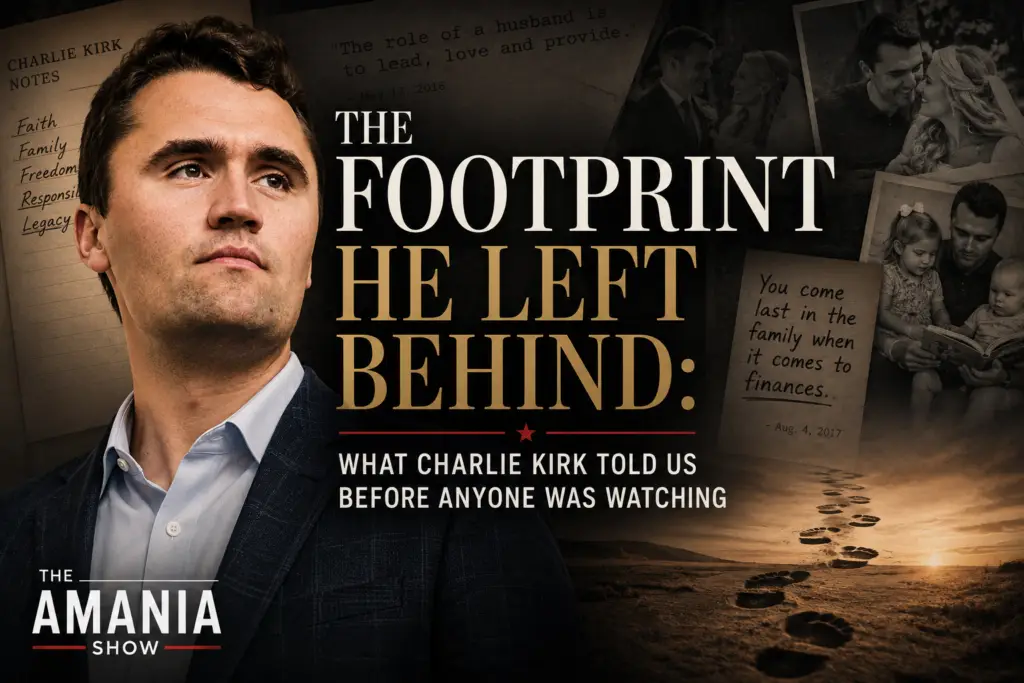
A Man Who Left Receipts
There is a particular kind of person who is very difficult to write about after they are gone, and it is not the person who left nothing behind. It is the person who left everything behind.
Charlie Kirk was that second kind. He built a public life out of talking, constantly, on camera, in front of hostile crowds and friendly ones, in long form interviews and in ninety second campus exchanges. And in the course of all that talking he did something that most people never do. He described, in specific and repeatable terms, the exact man he intended to be. He did it years before he was married. He did it years before he was a father. He did it at an age when almost nobody would have held him to it.
That is where Episode 10 of The Amania Show begins. Not with politics. Not with Democrat or Republican, liberal or conservative. With a simpler and much harder question: who was Charlie Kirk, the man?
As Amania put it on air, we do not have to guess a whole lot, because he spent years telling us exactly who he was and what he wanted.
He Started With Responsibility, Not Authority
The clips in this episode are arranged to build an argument, and the argument gets sharper with each one.
He is asked about feminism and gives a wave by wave answer, but what he keeps returning to is not policy. It is purpose. It is the family unit. He argues that men and women were made for complementary roles rather than identical ones, and Amania flags that word immediately, because complementary is doing a lot of work in everything that comes after it.
He tells a young woman in Las Vegas that more young women should marry earlier and start families earlier, and that being a partner at a local law firm is not the achievement the culture says it is. It was one of the most controversial things he ever said, and Amania does not pretend otherwise. But she pushes back on the reflexive reading. Was he attacking women, or was he urging a different road and being blunt about the trade offs of the road most people take?
Then comes the clip that reframes everything. Asked how to encourage young fathers, Charlie Kirk does not talk about headship. He talks about the bill. He says a father is tasked with protecting his children physically, spiritually and emotionally. He says a man should not spend a dime on video games or sports or himself until his wife has no financial pressure. He says you come last in the family when it comes to finances, period. And then he says the line that reveals the whole framework: you want all the benefits of being called the head of the household, but none of the responsibilities or the obligations.
Listen carefully to the ordering, Amania says on air. He almost never started with authority. He always started with responsibility.
That distinction is the spine of the entire episode. Provider, not dictator. Provider, not king. Provider, not boss. Someone whose own needs come last by design.
Two People, One Arrangement
Ideas do not become a life until somebody agrees to build with you. For Charlie Kirk, that person was Erika Frantzve, and by the time she married him there was nothing hidden about what he expected. It had all been said out loud, on the record, for years.
Speaking beside him at AmericaFest, Erika Kirk described her side of the arrangement without hedging. He is the head of the household. She is not a servant and not a slave to the master. She is his helpmate. She is the guardian of the home, and that is her domain. Those four walls, she said, are what he comes home to after battling and building. A soft landing.
Amania draws the point out slowly and deliberately. Erika Kirk did not describe herself as a corporate executive. She did not describe herself as a public figure. She described herself as the guardian. Two roles, one mission, each person clear about which one was theirs.
Then there is Charlie the father, and honestly these are the clips that land hardest. He takes his daughter to the New York restaurant where he first met her mother and tells her the story of how it started as something close to a job interview until he decided he already had enough friends. He tries to teach a small child Newton’s laws and warns her, straight faced, that she is going to be quizzed on this later. He tells her the quality that made him marry her mother was that she was Christ like.
These are not policy moments. They are ordinary ones. And that is exactly why Amania included them.
The Sentence He Would Not Let Anyone Take From Him
There is one clip in this episode that does not fit the warm tone of the others, and it is the most important one.
At Politicon in 2018, in the middle of a debate, Charlie Kirk is accused of not practicing what he preaches. And he comes out of his chair. The composure that made his whole career work simply vanishes. He demands that they ask about his salary. He insists he lives like a capitalist every single day. He sits back down and says it plainly: I practice what I preach.
Amania makes the case that this reaction is the tell. Of all the accusations aimed at him over the years, that is the one he could not absorb. He would not be called a hypocrite. He wanted the private life and the public life to be the same life.
Which is what makes the question at the center of this episode a fair one to ask.
The Question The Episode Is Actually Asking
Charlie Kirk provided. That word carries the weight of everything he built. Turning Point USA and its branches, the structures, the security, the future. He built so that his wife would not need anything and his children would not need anything, whether he was here to see it or not.
So Amania asks, carefully and with her disclaimer restated, whether the arrangement we are watching today is the one he described. His widow now leads the organization. She is at the helm. Amania is explicit that there is no proof of anything improper, that she wants to extend grace, and that she is not trying to throw anyone under the bus. But she also refuses to pretend she does not notice the gap between a man who said his wife should never have to carry that weight and a household where that weight is now being carried.
The children, she says, are the ones who lose in this. They have already lost their father. Her concern is what happens to the guardian role while everyone is busy building.
You do not have to agree with where she lands. But the question is built entirely out of Charlie Kirk’s own sentences, and that is what makes it hard to wave away.
Two Widows, Two Very Different Roads
Culture Corner opens with Butler, and with a name that has been slipping out of the national conversation for two years.
On July 13, 2024, at the Butler Farm Show grounds in Pennsylvania, Corey Comperatore, a fifty year old former volunteer fire chief from Sarver, threw himself over his wife and daughter when the shooting started. He was killed. His wife Helen was close enough to feel a bullet pass her face. She was looking directly into his eyes when he was hit.
Two years later, in an interview with NewsNation, Helen Comperatore said she does not believe there was a second shooter, but she does believe the gunman was working with somebody, and she said she believes it was an inside job somewhere inside the government. Asked what would give her closure, she said it would come when the people who put that day together are caught and it comes out. Asked what she would say to the President, she said: do not forget us. We are still here and we need answers.
It should be said plainly that federal investigators have publicly concluded that the gunman acted alone, and Helen Comperatore has not presented evidence of an accomplice. Amania does not claim otherwise. What she highlights instead is the conduct that keeps the questions alive. A federal review documented that the Secret Service failed to establish a joint communications room with the local law enforcement officers who had been passing along reports about a suspicious person. Reporting on the two year mark noted that the agency did not sit down with Helen Comperatore until roughly a year after the man she loved was killed at an event it was responsible for securing.
And then Amania does the thing that makes this segment sting. She puts the two widows next to each other. One is two years out and still asking. One stood on a stage and offered forgiveness. Amania is direct about her own reading of that second moment, and she is equally direct that it is her reading. What she wants the audience to sit with is the contrast itself.
One widow says we need answers. One widow says we are going to build.
A Seat Nobody Voted For
The last story is short and it lands like a stone.
South Carolina Republicans went to the polls on June 9, 2026. Senator Lindsey Graham won that primary with roughly fifty nine percent. Businessman Mark Lynch finished second with roughly twenty seven percent, which is not a rounding error. That is a real bloc of voters who showed up and made a choice.
Graham died on July 11 at the age of seventy one. Governor Henry McMaster appointed the senator’s sister, Darline Graham Nordone, to serve out the remainder of the term, and she was sworn in on July 14, becoming the first woman to represent South Carolina in the United States Senate. A special Republican primary for the November ballot is set for August 11.
Amania is careful to say rest in peace. Her argument is not about the family. It is about the sequence. Voters were asked for their preference weeks earlier. Then a seat changed hands by appointment. Her question, and the one the chat asked right along with her, is a simple one. What exactly did that primary accomplish?
That is a perfect example, she says, of taking the people’s vote and throwing it in the trash bin.
Where It All Lands
The last clip of the main segment is the last interview Charlie Kirk ever gave, recorded on the morning of September 10, 2025, hours before he was killed. He is asked for a quote he lives by, and he gives two. This too shall pass, which he correctly notes is not scripture, and Romans 8:28, that God works all things for good for those who love Him.
He said it was freeing. He said it meant he did not have to be in charge of everything. There is a God, and I am not Him, and I surrender to His will.
Amania takes that and runs it forward through everything else in the episode. Through Erika Kirk. Through the Kirk children. Through Butler. Through a widow in Pennsylvania who cannot put it down. God is working it out, she says, and He is working it out even when we cannot see the shape of it yet.
That is the posture this show keeps returning to. Ask the hard question. Refuse to pretend you did not notice. And hold the whole thing loosely enough to believe it is going somewhere.
We come with a sword, the sword of truth.
Blog SEO Keywords
Charlie Kirk in his own words, who was Charlie Kirk the man, Charlie Kirk provider, Charlie Kirk on marriage, Charlie Kirk practice what I preach, Erika Kirk guardian of the home, Erika Kirk Turning Point USA CEO, Charlie Kirk final interview, Charlie Kirk Romans 8:28, Helen Comperatore, Corey Comperatore, Butler Pennsylvania two years later, Butler rally answers, Lindsey Graham Senate seat, Darline Graham Nordone, South Carolina special primary, The Amania Show, faith and culture podcast, investigative commentary, Amanianites
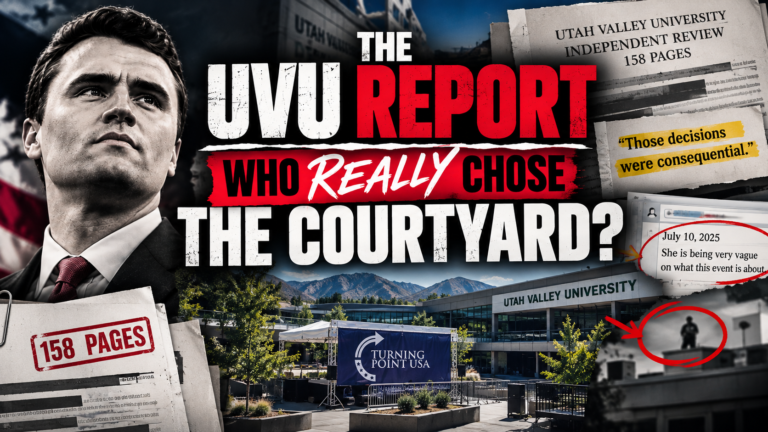
For a year, anyone who asked hard questions about what happened at Utah Valley University
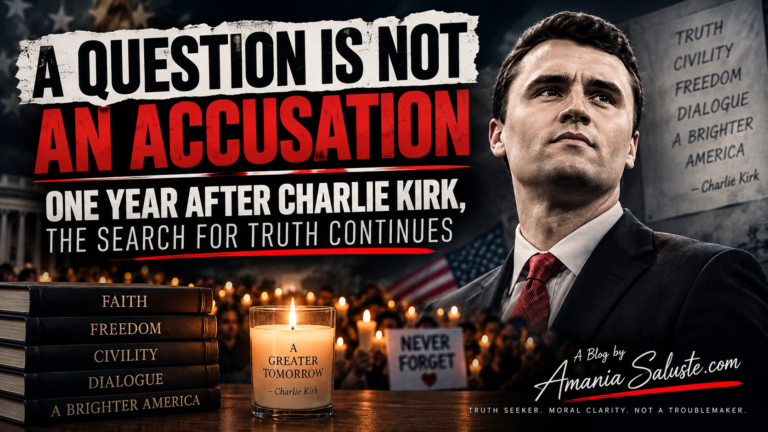
A Question Is Not an Accusation: One Year After Charlie Kirk, the Search for Truth